🥙 Pita: Devlog 1

Listen to this post

On June 28, 2005, Apple release iTunes 4.9. From the release notes:

With iTunes 4.9, you can now browse and subscribe to podcasts from within the iTunes Music Store. Podcasts are frequently updated radio-style shows downloadable over the Internet. You can also transfer podcasts to iPod, for listening on the go.

At launch, Apple's podcast directory was home to 3,000 shows. The BBC at the time described podcasts like this:

Podcasts are downloadable audio shows that can be created and listened to by anyone with the right equipment.

Who could have imagined that podcasts would grow to become an entire media category, right alongside film, television, music, and books?

In 2020 over 1,000,000 new podcasts launched! That number has died down quite a bit – only a quarter that many in 2024. Even so, there remains 260,000 active podcasts as of this writing.

Despite the popularity of podcasting, publishing a podcast still requires a good amount of time, skill, and money. There are some great tools to help, but there are also some gaps.

The way I see it, a podcast production workflow requires three keys steps1.

1. Record

This step is well covered by existing tools. You could use music production software like Logic or Garageband, a simpler tool like Voice Memos or Quicktime, or a SaaS that also handles video calls like Riverside. Most of these tools have native Mac and iOS apps. Most are easy to use and well established.

2. Edit

When it comes time to edit, things get a little trickier. You could learn some of the more advanced features of Logic or Garageband, keeping the editing and recording software the same. Or you could try AI tools like Descript which automatically trims silences and remove filler words. Many podcasters swear by Ferrite, an iPadOS native app that makes podcast editing famously simple using the Apple Pencil. Again, there are many native apps, and while editing software can be more complex, there's lots of help to be found online.

3. Publish

This is where things take a bit of a turn. You've recorded and edited your podcast in Garageband, and managed to export it as an M4A file. Now what? Or maybe you recorded in Voice Memos on your iPad, and edited using Ferrite. Again, what to do now that you've exported that file?

There's really only one answer: Find a podcast hosting platform to take care of the rest for you. You're kicked out of these simple native experiences, and suddenly find yourself logging into a web page (each host with a different UI), with top-bar navigation and an upload button.

Good luck doing it on iPhone. And don't forget the monthly subscription.

Publishing is really quite a departure from the user experience of recording and editing your show. There's a real friction there, while you wait for web pages to load so you can manage the description and meta data for any one of your episodes. This is not what it should feel like to publish a podcast!


I'm working on an app to fix this. It's called Pita. It's based on 3 Principles for Podcast Publishing.

1. A Native Interface

Podcast publishing should feel native, like editing an Apple Note or using the Mail app. There should be workflow support to drop a new episode in through the Share Sheet, or a Shortcuts integration. Our podcasts are important to us. We want to see how they're faring with widgets and notifications.

2. Hosting Independence

A podcast publishing app should support any hosting provider. Why learn a whole new interface for each of the different hosts you engage with? Publishing a podcast should be like opening your favourite FTP client and choosing which server configuration to connect to. Or an email app that supports multiple accounts. All your podcasts, managed from a single app interface, no matter where they're hosted.

3. Support to Self-Host

You might not want to pay a $12 monthly subscription to host your podcast! Perhaps you have a cheap S3 bucket ready to go, or would be happy to host your podcast with a Creative Commons license for free through the Internet Archive. There should be an app which enables these self-hosted options, with an auto-generated RSS feed based on your episode data.


So that's what I'm building. It's still early days, but a work in progress nonetheless. Stay tuned, and if you like the idea, please let me know! Those feedback loops help keep me motivated.
An early build of Pita.

An early build of Pita.


  1. Arguably, we could extend the three podcast production steps to five or six. Most podcasts also need to distribute, promote, and monitor analytics. However, these seem ancillary to the primary production pipeline, so I've not included them here. ↩︎
Malleable Software

Listen to this post

Ben Thompson's aggregation theory posits that the internet created an entirely new disruptive business paradigm, because for the first time in history, products could be distributed with zero marginal cost.

Now, large language models have triggered a second wave of disruption: while the internet eliminated distribution costs, AI is eliminating creation costs – making software essentially free at every stage.

Internet = zero marginal cost
Internet + LLMs = zero total cost1

Geoffrey Litt, via X:

Today's software ecosystem evolved around a central assumption that code is expensive, so it makes sense to centrally develop and then distribute at low marginal cost.

If code becomes 100x cheaper, the choices no longer make sense! Build-buy tradeoffs often flip.

LLMs are making software development quick, easy, and accessible to everyone. So the big question is: How will this disruption change the way we use our computers?

One likely answer is that we'll see a decline in bundled software, in favour of scripting tools and API services. Rather than subscribing to an accounting SaaS, which might meet most of my needs (with a bunch of other features I'll never use) I can just build my own accounting software, specific to my particular use-cases.

Since I own the source code, and an LLM can be given full context into how the software is written and what my business needs are, features can be added as needed.2

A personal anecdote:

Yesterday I was wondering how I might be able to host a podcast for free. I had a few requirements, very niche.

  • Convert my M4A files to MP3
    • Attach my show artwork, show name, and episode title
    • Use 64kbps mono
  • Upload the converted file to a free hosting service (the Internet Archive)
  • Copy the public URL of the service to my clipboard

I could have simply chosen to host with Buzzsprout or [choose your favourite podcast hosting platform] and paid a monthly subscription. But in about 4 hours, I was able to get a much more personalised solution up and running. Not only is it free, it's a simple AppleScript droplet that I can pop my recorded audio into, and have a URL returned in about a minute. Just what I was looking for.

If I didn't know that Claude was capable of the heavy lifting, I'd have never bothered with the project. I'm a capable senior software engineer, but this sort of project would just have taken too long and required too much mental effort.

The shift from bundled software to personalised solutions isn't just about cost or efficiency. It represents a fundamental change in our relationship with technology. When software becomes malleable, shaped by our exact needs rather than vice versa, we move from being passive consumers to active shapers of our digital environment. We create software that can bend to fit us, rather than us bending to fit it.


  1. When we say "zero cost", we're rounding down. Of course distribution online does have a cost to it – hosting isn't usually free. And building software with AI still does take some time. The point is that the costs have been so far reduced as to be essentially zero, comparatively. ↩︎

  2. AI isn't perfect, and maybe it won't ever be. We might see small development teams added to small businesses to develop all their in-house software, with everything built precisely to requirements by AI, and guided by human engineers. ↩︎

Housekeeping

Listen to this post

A little housekeeping post, with a few updates to the website.

First of all, if you're reading this in your RSS reader, THANK YOU for keeping the dream alive.

You might like to click through for this post, because I've made some small changes to the website.

I've updated the header with some neat ASCII art, and I've been adding a little more detail to the About page.

I've also added an email subscription option, using the excellent Buttondown. Let me tell you about Buttondown (not a paid endorsement, just a recommendation).

So email newsletter software is largely terrible. I've tried MailChimp, Campaign Monitor, Brevo, even a native Mac app called Direct Mail. The story is the same – polished brands, terrible software. Hard to use, full of bugs (especially Brevo), and clearly steered toward nabbing your sweet sweet monthly subscription.

Buttondown is a bit different. Firstly, it actually includes my niche feature request out of the box (automatically trigger a new email whenever I publish a new post), instead of having to jury-rig some Rube Goldberg Zapier stack.

Secondly, it's got just the right amount of personality. I love that in software. It really has small-team vibes, in the very best way possible. The developer behind this is clearly influenced by the likes of Jason Fried, Amy Hoy, and DHH (complete with homepage manifesto). It's so easy to use. Everything just landed under my fingers.

Also, this, this, this, and this.

Lastly, I've been working on a new feature, to provide yet another way of keeping up to date. I'm working on adding a Podcast, which will mostly just be me reading each post. But who knows, maybe I'll throw some bonus content in there too. I'm hoping to have that live by next week.

Thanks again for reading!

Documenting Uninteresting Minutia

Listen to this post

I was inspired by something I saw on Joshua Wold's blog a few days ago. He was reflecting on why we write.

When I sit down to put words to the page I have an idea of what I want to write. But I’ve purposely chosen not to plan it out.

The experience is much the same for me, except that sometimes I don't have an idea of what I want to write.

Sometimes you've got to just power through and write anyway. And there's a tension there– am I writing for myself or for an audience?

Because if I write for myself, then I'm likely to blather on, documenting uninteresting minutia. Getting words out for the sake of getting words out, because getting words out feels natural and cathartic. This blog's origin was an unfiltered journal with a voyeuristic audience.

But if I write for an audience, it's so easy to tell myself "it's naval gazing1", or "it's not good enough", or "who cares?".

I'll hold that tension.

For me, a large motivating factor is recording a piece of myself for my children. The more I write, the better they'll know me. It's easy for kids to forget that their parents are actually real people, so one day, when they realise this fact, they might take an interest in learning about their Dad. And, more morbidly, someday (B"H many years from now) they'll have a little extra to remember me by.


  1. Like this article. Archetypal naval gazing. ↩︎

Circle of Fifths

Listen to this post

My method for practicing bass guitar is based on the Circle of Fifths, inspired by a method taught by Scott Devine.

The Circle of Fifths is a music theory concept which links each of the 12 notes in a sequence. Start with a note, and increment it by 5. Play that "fifth", and then increment another five. As a bit of code, it could be expressed like this:

notes = ["C", "D♭", "D", "E♭", "E", "F", "G♭", "G", "A♭", "A", "B♭", "B"]
index = 0;

while playing {
    index = index + 5 // Move foward 5 notes in the sequence.
    index = index % count(notes) // Make sure our index is within range.
    play( notes[ index ] )
}

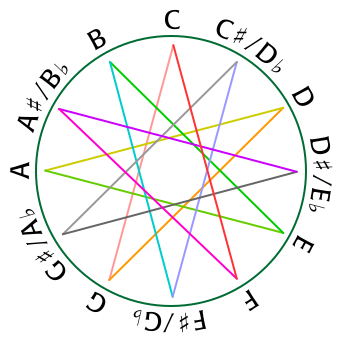
In other words, count forward 5 notes, looping back to the start as needed. This would result in the following repeating sequence: C / F / B♭ / E♭ / A♭ / D♭ / G♭ / B / E / A / D / G.

Which results in a rather beautiful star dodecagram.

The Circle of Fifths

Step 1: Learn the progression

This progression is helpful to practice, because it's very common in many varieties of music. Additionally, bassists often enumerate a triad while playing, which includes the fifth note in the key. Practicing fifths help you find interesting harmonic structures. If the guitarist is playing a C, consider an F.

Step 2: Practice major triad shapes

A triad is simply the first (or root) note, third note, and fifth note in a scale.

 ↓     ↓     ↓
 1  2  3  4  5  6  7
 C  D  E  F  G  A  B

There are essentially 3 patterns you could use to deconstruct a major triad on the bass guitar. Here's a C triad, in those three shapes (R for root note, 3 for the third, 5 for the fifth).

Shape 1:
G|---|---|---|---|---|---|---|
D|---|---|---|---|-5-|---|---|
A|---|---|-R-|---|---|---|-3-|
E|---|---|---|---|---|---|---|

Shape 2:
G|---|---|---|---|---|---|---|
D|---|-3-|---|---|-5-|---|---|
A|---|---|-R-|---|---|---|---|
E|---|---|---|---|---|---|---|

Shape 3:
G|---|---|---|---|---|---|---|---|
D|---|---|---|---|-5-|---|---|---|
A|---|---|---|---|---|---|-3-|---|
E|---|---|---|---|---|---|---|-R-|

I practice these by playing through the Circle of Fifths using shape 1 first, then shape 2, and finally shape 3.

One thing I do to help me know when I've "got it under my fingers" is to throw a drum track on (I use my electric piano for this). When I'm comfortable playing through each sequence with a 110 bpm, that's when I know to move on.

Step 3: Practice inversions

When I first start practicing the major triads in their various shapes, I'll be playing the triad in order: R / 3 / 5. But as I'm feeling more confident with this, I'll invert the triad once (3 / 5 / R) or twice (5 / R / 3).

Keeping in the Circle of Fifths sequence, you get this:

  • (C chord) E / G / C
  • (F chord) A / C / F
  • (B♭ chord) D / F / B♭
    … and so on.

Of course each of these inversions can be played in each of the shapes listed above! So go through each inversion using each shape. Again, a drum track helps a lot!

Step 4: Combining shapes

Okay with this next step I implement some limitations on myself in order to force brain and fingers into uncomfortable territory.

The task is: Play through the Circle of Fifths triads using only fret 1–5 (or fret 6 if necessary). No open notes.

Once I'm feeling comfortable here, I'll move the whole thing up the neck, playing frets 6–10, or 8–12. This usually takes some time to figure out – I'm still becoming familiar with the notes north of the fifth fret! But that's why it's good practice.

Limiting the frets in this way forces you to choose a different shaped triad for each note in the circle.

Repeat with each inversion. Or sometimes I just throw in a random inversion while I'm playing through.

Step 5: Minor triads

Rinse and repeat steps 2–4, but using minor triads instead. Figure out your shapes, and proceed from there.

 ↓     ↓     ↓
 1  2  3  4  5  6  7
 C  D  E♭ F  G  A♭ B♭

You could even do the same for diminished or augmented chords, but I haven't bothered to learn these yet.


Many of these concepts have helped me on other instruments, too. Inversions on piano, and chord progressions on guitar. I'm not sure if bass is the best lens with which to approach a new instrument, but it's one that's worked for me so far.

Turn-Based Podcasting

Listen to this post

Every so often you'll come up with an idea that you're pretty sure nobody has tried yet.

99% of the time you're wrong.

But I think our invention of the turn-based podcast falls into that 1% of truly unique ideas.

Joshua and I have been working asynchronously for nearly our whole careers. So when we started a podcast that required a scheduled calendar event every week, something didn't quite sit right for us. So we decided to try something really different.

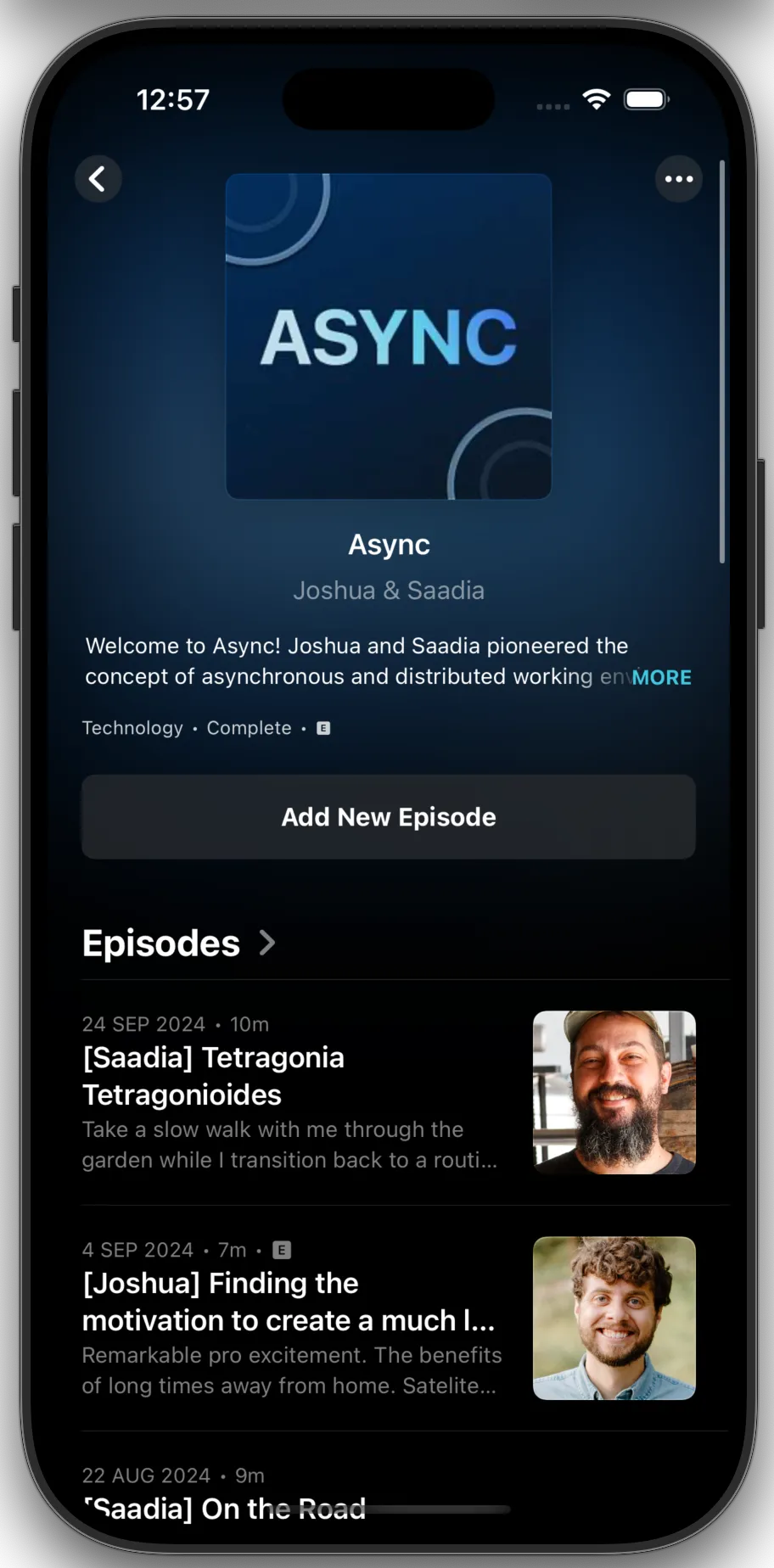
The podcast is called Async, and you can find it on all the best podcast networks. It's a podcast about technology, app development, and remote work. The unique aspect is that each episode alternates between hosts, switching back and forth between Joshua and me. This allows our conversation to unfold gradually over multiple short episodes.

Since this episode-to-episode asynchronous exchange is a new idea, I thought it would be good to define the term "Turn-Based Podcasting" a little more, and talk about the pros and cons of this novel format.

What is turn-based podcasting

I never liked the game Age of Empires. Some people will tell you that it's all about strategy, but they're wrong. It's all about speed. How fast you move your cursor, how well you know the shortcuts, how quickly you can react. This type of game is called "real-time strategy", because you're thinking and reacting synchronously with other players.

I've always preferred games like Chess, or Polytopia. In these games, play progresses in turns, each player receiving all the time they need to decide on the best course of action. These are "turn-based strategy" games.

Most podcasts are real time conversations. Sure, they're often heavily edited, and the end product may not be chronological, but the production requires collaborators operating concurrently.

Turn-based podcasts allow each host the time they need to think through a response, responding whenever is most suitable. Joshua will record an episode, which will appear in my podcast feed. Once I've had a chance to listen, I will record my response – often including a new topic or idea for Joshua to react to – and publish it. Each episode passes from one to the other, like a relay race passing on the baton1.

Turn-based podcasting is not limited to two hosts, nor does it require hosts to participate in a particular turn-order. The key distinction is that each episode contains a single speaker.

How is this different from asynchronous podcasting?

Asynchronous podcasting involves recording audio asynchronously, then stitching the segments together to form a single episode. Often, the interviewer records all of their questions all at once, and later, the interviewee answers them. The two audio clips are merged, and voila! You have an episode that was recorded asynchronously, but sounds synchronous (although, these types of shows often seem to be lacking a certain je ne sais quoi).

Turn-based podcasting, on the other hand, leans in to its asynchronous nature, rather than trying to hide it in post.

What are the advantages of turn-based podcasting?

The primary advantage is flexibility. Joshua and I are both busy working Dads, and our weeks are constantly in flux. We love podcasting, but between work, kids, family holidays, and religious events, we can't realistically dedicate a calendar slot every week.

Turn-based podcasting gives us the flexibility we need to make the conversation happen.

Another huge advantage is the time-to-publish. Since the listener (and responding host) needs to keep track of various topics and threads across episodes, we recommend keeping each episode short. Five to fifteen minutes works best for us. I listen to Joshua in my own time (driving, cooking, washing up) so the time I spend sitting at the microphone is limited only to my response.

Joshua and I pair our turn-based podcast with a live-to-tape policy. Without an edit, it takes me 15 minutes to record an episode, 5 minutes to upload and write a title, and another 5 minutes to add AI transcription and chapter markers. I consistently get an episode out in less than half an hour.

Lastly, our release frequency changes the game. Since our episodes are short, we tend to release 3 or 4 back-to-back episodes every week. This keeps us in regular rotation for our listeners, and top of mind.

What about the disadvantages?

If you look at any poll asking people what they like about podcasts, it's inevitably the conversational flow and the chemistry between the hosts that draws listeners.

There's no getting around the fact that verbal backchannel cues and even interruptions make for a more dynamic conversation. Turn-based podcasting misses out on that. Even so, over the course of a few episodes, listeners discover a flow between hosts. There are in-jokes, references, sledging, and snide remarks. The chemistry can be a little more subtle, a little more long-form, but it's there.

Won't listeners get confused?

Maybe? I mean, you've got to give listeners a little more credit than that, right? If you explain the situation up front, I'm sure the audience can figure it out. Here's how I introduce the Async podcast:

Saadia

Hi, welcome to Async! This is Saadia. Async is a back and forth conversation between Joshua and myself about technology, app development, and remote work.

Additionally, we recommend prepending each episode title with the name of the host in square brackets, like so: [Joshua] Pausing infinity wells.


I love podcasting. Talking through my thoughts and experiences helps me process them in a way not dissimilar to journalling or blogging. It helps me think. Finding a format that fits my lifestyle has really opened that up for me, and most importantly, made it sustainable.

Turn-based podcasting may not have the conversational dynamism of traditional formats, but it brings something unique to the table: flexibility, thoughtful exchanges, and a unique rhythm.


  1. I considered terming the practice "Relay Podcasting", but that might get confused with one of our favourite podcast networks: Relay FM↩︎

Syndication

Listen to this post

On a drive with Talia yesterday, I wanted to tell her about some of the interesting things I discovered while writing my Input 2024 post. The conversation went something like…

Saadia

Let me tell you about something I wrote, since I know you don't read my blog.

Talia

How do you know I don't read it?

Saadia

Because you don't use an RSS reader! Do you?

Talia

No, you're right, I don't.

Saadia

So how would you know when I've posted something new? You're not going to go check it everyday. It's fine! You don't need to. Let me just tell you about it.

You might have heard about this "Indie Web" movement, also called the "Small Web", "Web 1.0", or "Geocities Web". It's a push to reclaim something about the internet that we lost along the way. I think that something was, specifically, RSS.

The best web died on July 1, 2013.

In the days following it's closure, Marco Arment suggested that the shutdown of Google Reader was a strategic move to push users toward sharing content on Google+. While the plan didn’t fully succeed, the overarching trend became clear: RSS feeds were on the way out, and social networks were taking their place.

Ever since then we've been on a free-fall into short-form, high-speed, hyper-stimulating, outrage-inducing, brain-rotting, algorithm-pleasing "content".

RSS lives on in podcasting. It's a remnant of the Indie-Web which persisted, and is thriving. Could long-form textual content ever see that same sort of popularity? Or are those days behind us?

Here's an app idea: Imagine a mashup of Apple Podcasts and Apple News. Your feeds are arranged in beautiful bento layouts, and a Discovery tab helps you find more blogs to follow. There's a section called "Recommended based on my Feeds", and another called "New Perspectives to Explore".

The truth is that the audience for this blog is limited to those who have a habit of using an RSS reeder, and that's a pretty small demographic. I'd love to see an initiative that included RSS education, promotion, and discovery. What could we do to bring back RSS?


Update: As though to further confirm the idea that RSS is dead, I was having coffee with Rob yesterday. He's a marketing manager for a big tech company. He's worked in tech his whole career. I asked him whether he uses an RSS reader and he laughed at the idea.

Today, another friend came around – Jeremy. He's an avid gardener, and started an amazing substack related to gardening and caring for the planet. I told him that he should write a new post, and that I'd add his substack to my RSS feeds. He replied, "What's that?".

Input 2024

Listen to this post

Since 2021, I've recorded every Book, Film, and Television series I've seen each year.

Usually, I'll write a round-up post at the end of the year with long lists of every title. For my 2024 roundup, I've decided to keep it a little more succinct.

Those who know me know that I think a lot about Input and Output. What creative information do I take in, and what creative acts do I undertake? I believe a healthy mind has a good balance between these two.

Here are the best and worst of my Inputs for 2024.


Books

In 2024 I read 25 books – roughly one every two weeks. Of these, 36% were graphic novels, 32% were audiobooks, 20% were ebooks, 1 paperback, 1 hardcover, and 1 printed screenplay.

There was a conscious effort on my behalf to try new mediums. In 2023, my reading was about 80% audiobooks, so the inclusion of ebooks, a screenplay, and a bunch of graphic novels was, well… novel. In 2025, I think I'll hunker down with a few more physical books.

Book of the Year: The Swallowed Man by Edward Carey

An unforgettably woeful tale of Geppetto, the father of The Wooden Boy, Pinocchio. The audiobook was great – and if you can, I'd recommend listening this way. It's read by the author, who, despite not having a particularly charming radio voice, must surely have some background in theatre. Touching and poignant are such overused words, so I'll simply say that this story burrows – no, dives – deep, lodging itself, and lighting up in the dark corners of your inner self.

Runner Up: The Great Undoing by Sharlene Allsopp

A thought-provoking and character-focused hard sci-fi, set in a near future apocalypse where Australia has become the dominant world power.

Wooden Spoon: Rebel by Bernard Cornwell

What a letdown! After thoroughly enjoying Cornwell's Sharpe series (my favourite book series ever written), I was desperately hoping that his ability to bring the Napoleonic wars to life would translate to the American Civil War. Alas, it did not. Despite a brief appearance by Sharpe's son and allusions to Sharpe's armaments, I found myself thoroughly bored.


Film

In 2024 I saw 41 movies. Of these, 34% were seen in a cinema, 29% on my television, 2 on my MacBook, 2 on my iPhone, and 1 on a plane.

Film of the Year: Monkey Man, directed by Dev Patel

I'm a sucker for a good, stupid, action film. Give me Fast & Furious, give me Taken, give me John Wick. And Monkey Man does. It's been described as an Indian John Wick – a fair comparison, but it's a lot more than that too. This film has a lot more heart than your typical shoot-em-up fare, plus the beautifully gritty backdrop of subcontinent slums. Hiding underneath it all are themes of poverty, the caste system, and Hindu nationalism. It's become my favourite action film, and my go to recommendation for anyone who enjoys the genre. This was Dev Patel's directorial debut, and I cannot wait to see what he creates next.

Runner Up: Napoleon, directed by Ridley Scott

I'm not quite sure why critics mostly panned this film. I enjoyed it quite a lot! Going into the film, I already had a strong interest in Napoleonic France (having read the entire Sharpe series, I feel like a minor expert!), so perhaps that helped. There were a few historical inaccuracies that bothered me (charging in line rather than column, as Napoleon was famous for). Aside from that, I found the settings and performances captivating, and the storytelling quite exciting.

Wooden Spoon: Madame Web

Enough has already been said about this terrible picture. I mean, I hate to speak ill of a film – there's such a huge amount of work that goes into every single one. But a dud is a dud.


Television

In 2024 I watched 30 season of television, across 23 different shows, comprising of 283 episodes. That's 5.5 episodes of television each week. Of these episodes, 22% were Outlander! An additional 12% were Marvel shows, and 11% were Star Trek.

Television Season of the Year: The Penguin (Season 1)

I know a lot of people skipped this because it's a DC show, and you know, Batman. It's set in the same universe as Matt Reaves' The Batman, but it doesn't feature the character in any important ways, and doesn't require that you've seen the film. The important thing to stress about The Penguin is that it is not a super hero show. There are no super heroes. The Penguin is a mafia drama, and a good one, holding its own right alongside Scorsese's GoodFellas. Frantic, fast-paced, never sure who to root for. It left me, let's say, staggering.

Runner Up: For All Mankind (Season 4)

Possibly the greatest show on Apple TV+, save perhaps Severance. And consistent. Every season has built on the last and taken the show new places. Season 4 is no different. The thing I'd say about this show is that it's a great "watch it with the wife" kind of show. It's been my experience with most couples that one prefers character drama while the other would rather gunfights and spaceships (or spaceships having gunfights). This show has it all.

Wooden Spoon: Monarch: Legacy of Monsters (Season 1)

After having enjoyed most of the previous films in the "MonsterVerse" franchise, and knowing the high calibre quality of Apple TV+ shows, I had high hopes for this series. Unfortunately, it was terrible.


This post should give you some indication of the types of Inputs I enjoy! If you have any recommendations, especially if they relate to one of the items above, please reach out and let me know! My favourite recommendations sound like "I saw you enjoyed X – you should try Y, it's like X but with a touch of Z".

Loofah

Listen to this post

Growing up, we always showered using (what my Italian mother called) a straccio. It wasn't until I was old enough to shop for myself that I encountered the plastic "shower puff", known also as a loofah1.

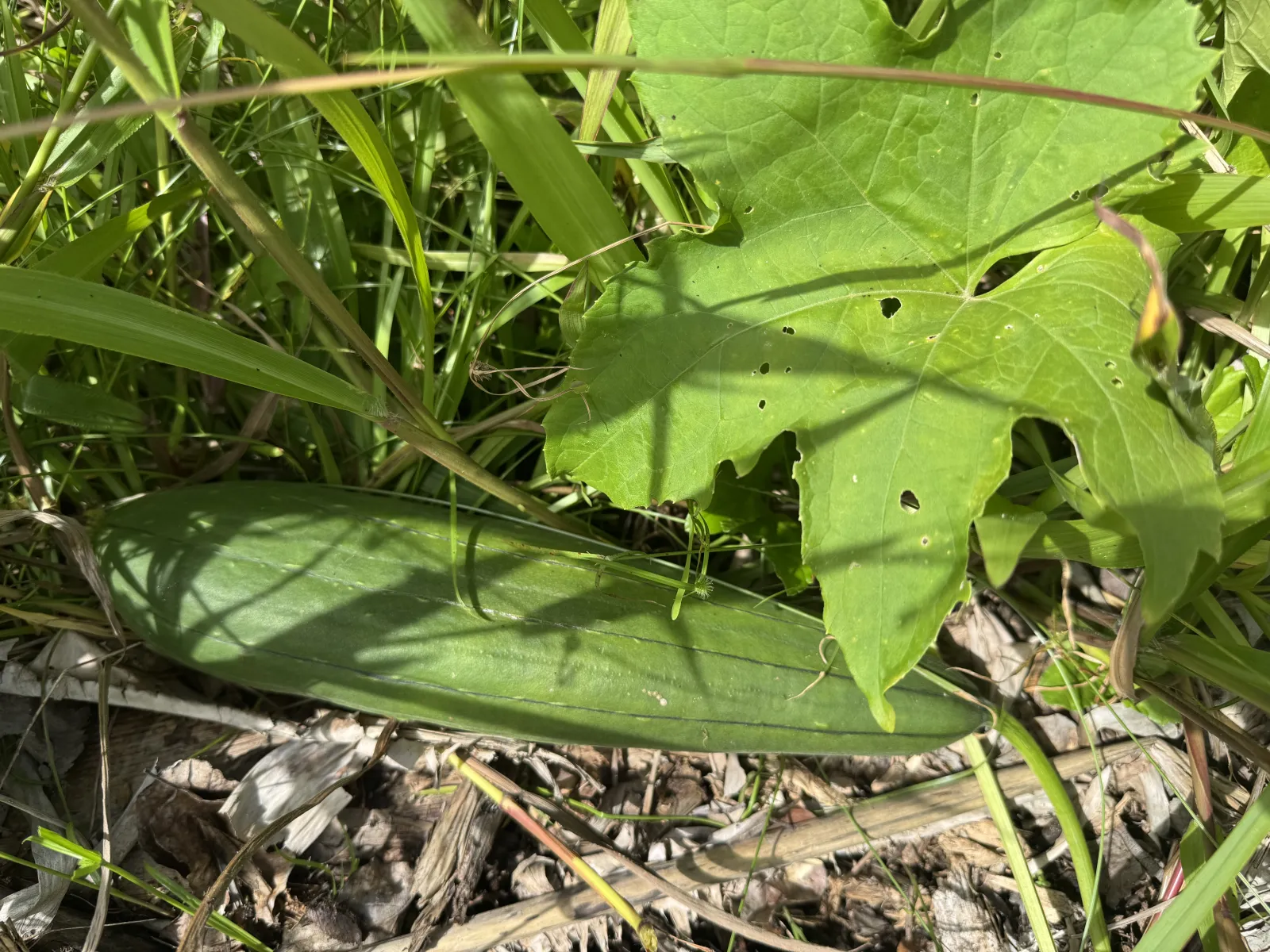
That word – loofah – occupied a very singular place in my mind (synthetic shower accessory) until a few years ago, when I discovered a loofah growing in my garden.

The crazy part was… that cucumber-like fruit turned out to be exactly the same thing.

A loofah growing amongst some weeds.

A loofah growing amongst some weeds.

In our garden we think a lot about beneficial plants. Harvesting food is amazing, and particularly rewarding, but many plants have uses beyond sustenance. We love weeds with medicinal properties, we plant flowers for pest control and pollinating, or we might grow a specific plant to improve the soil. Loofah's are beneficial too! They make great washers and scrubbing brushes.

Many folks I've talked to about loofahs don't realise that the plastic thing you buy in the supermarket is modelled on the real thing – a plant with a spongy texture that works great for scrubbing in the shower.

The loofah plant grows like a weed in our garden. It's a climbing vine, not dissimilar to cucumber or pumpkin. The fruit pictured above is just growing on the ground, but usually we'll grow them vertically.

I've read that it's best to harvest after the skin of the fruit turns brown (it becomes brittle and easy to peel), but personally I find that it's more effective to harvest them early and let them mature in a cool, dry place. Otherwise the rain and humidity can cause the sponge to rot. Additionally, harvesting early results in a paler and harder sponge, which is my preference.

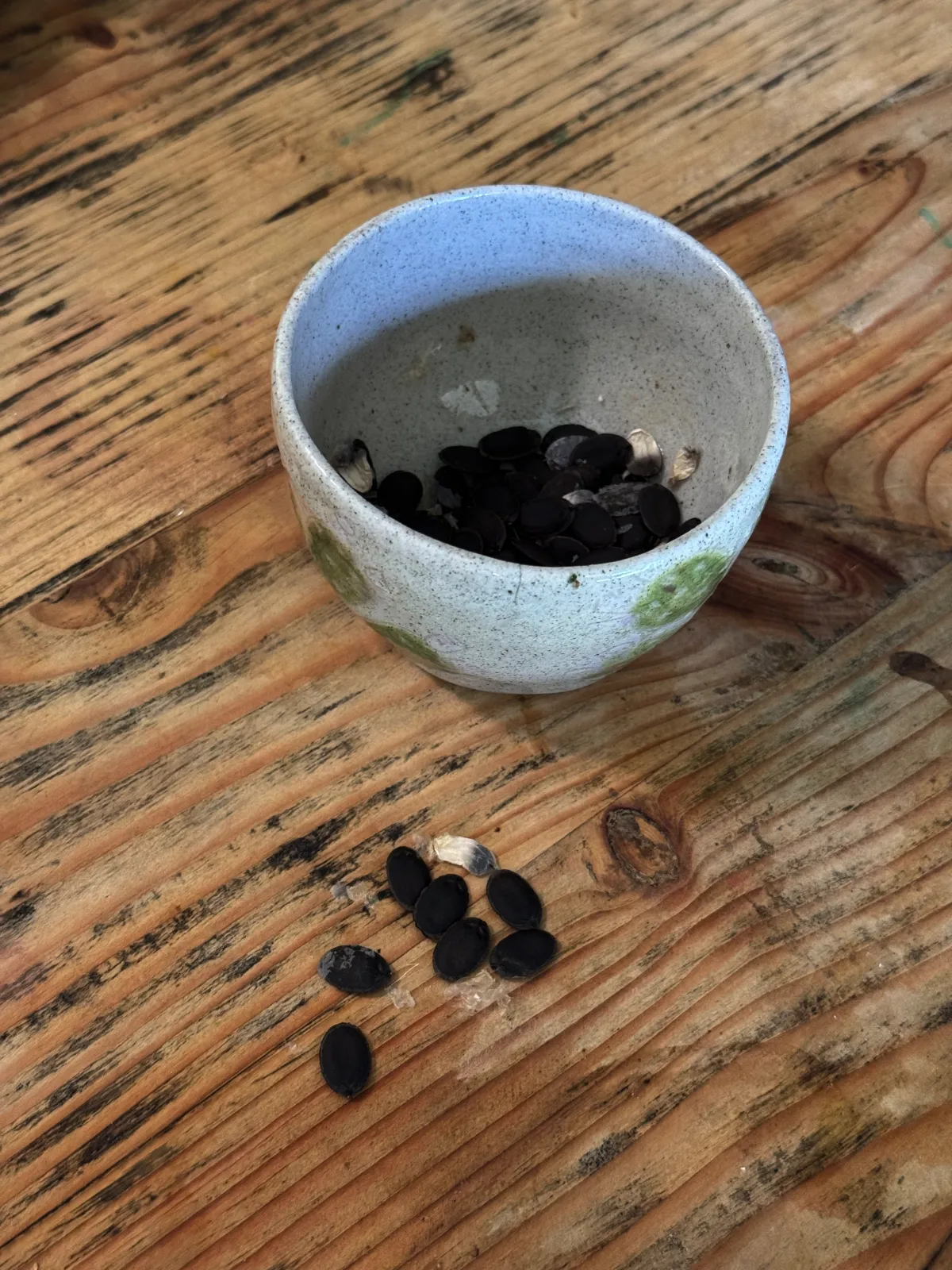
After the skin has gone brown, you peel it off, and shake out all the seeds! This usually takes me about 10 minutes, if I want to get all those stubborn hiding ones. We keep the seeds, and will plant them again. Here on the Sunshine Coast, they'll grow just about anywhere.

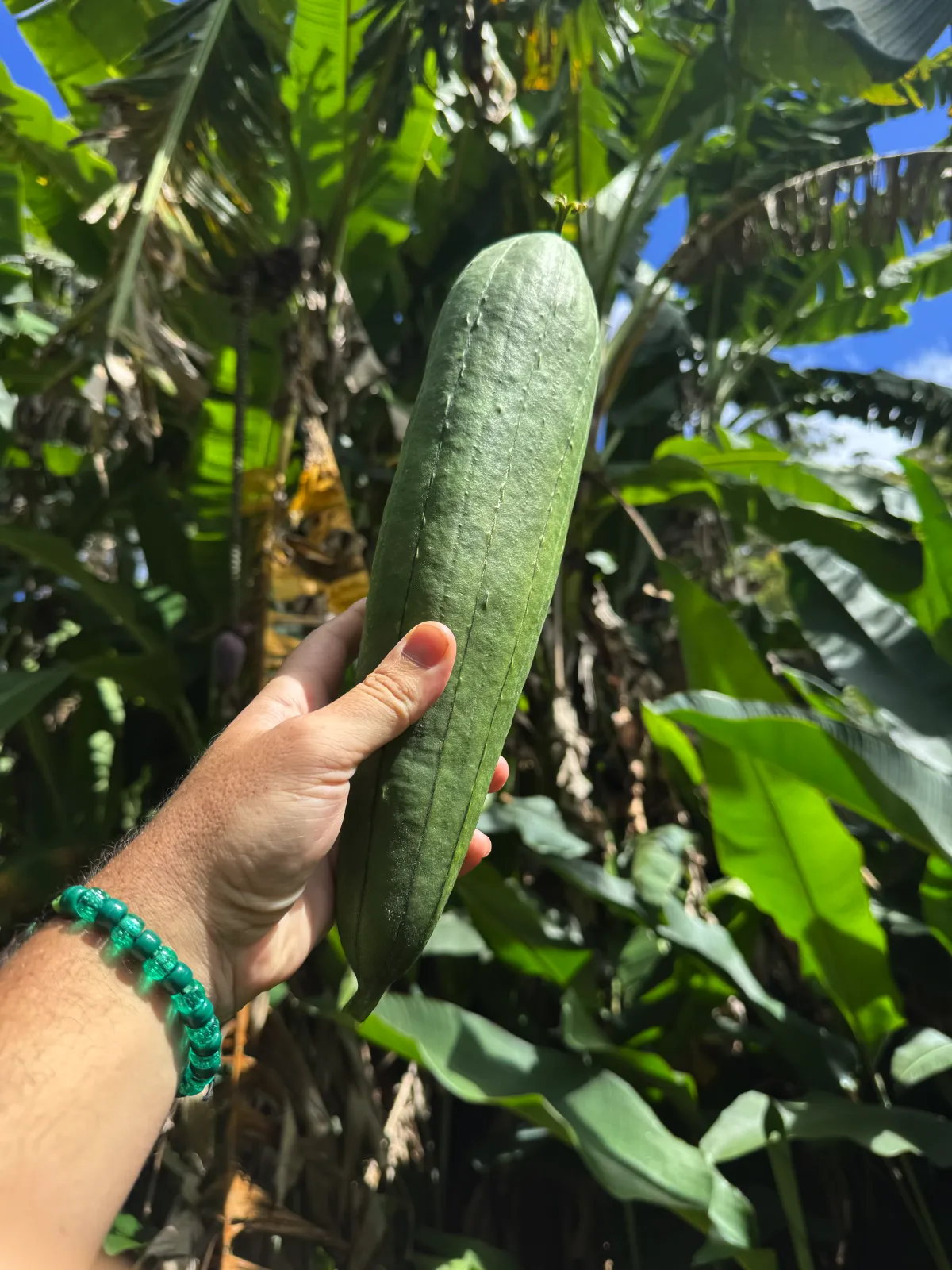
The loofah fruit, freshly harvested.

The loofah fruit, freshly harvested.

A bowl containing loofah seeds.

The loofah seeds, after shaking them out.

Some people prefer to bleach their loofah's before using them. I suppose this is to get rid of any unwanted dirt or plant matter. Others like to slice off the top and bottom with a bread knife for a more uniform cylinder shape. I prefer to keep things au naturel.

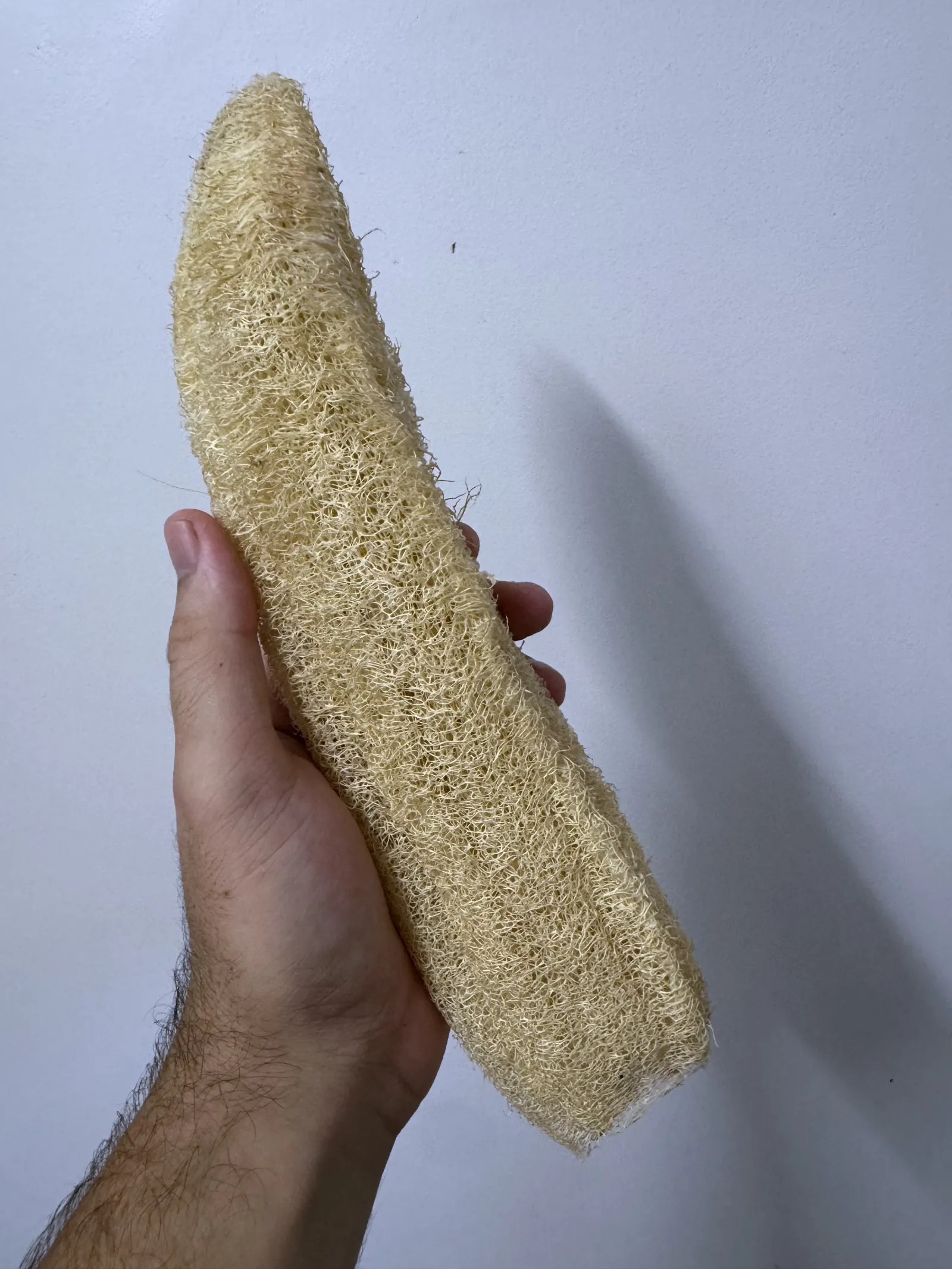
Showering with a home-grown loofah is amazing. It's hands-down the best body scrubber I've used. The sponge is exfoliating, but not too abrasive, and the length allows me to reach right down my back for a good scratch. Each loofah lasts about 3 weeks before it starts to rot.

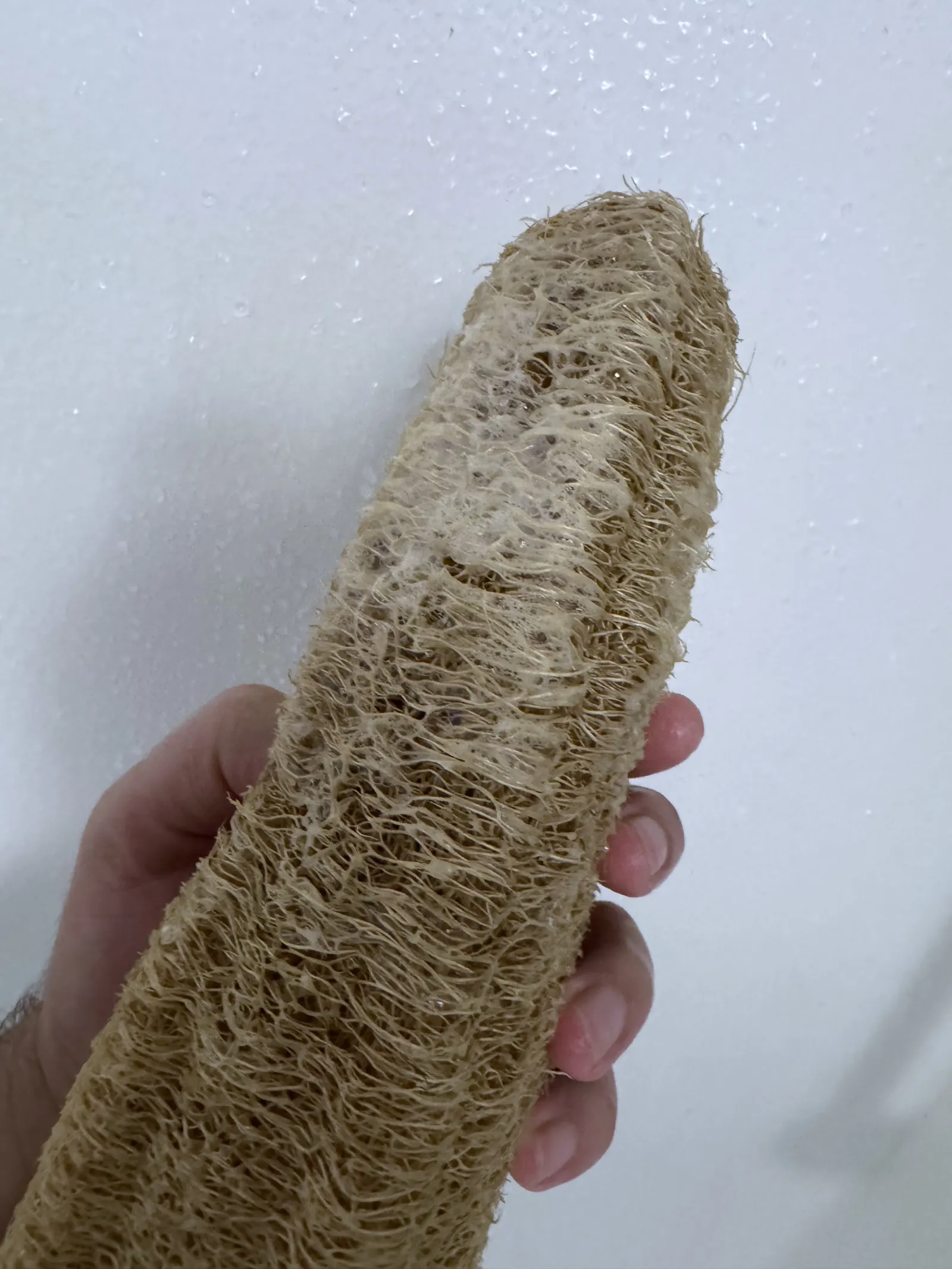
The loofah fruit, once it's been peeled.

The loofah fruit, once it's been peeled.

A loofah with soap lather.

Loofahs lather up great in the shower.

I've read that some folks make a soap using sliced discs of loofah, resulting in a sort of all-in-one body scrubber. I'm keen to give that a go using coconut oil, sunflower oil, and some caustic soda (or maybe I'll try my hand at home-made lye!).


  1. Luffa, to my friends across the pond. ↩︎

App Defaults

Inspired by Tobias Horvath (and a whole bunch of other bloggers), here are my App Defaults.

📨 Mail Client: Apple Mail
📮 Mail Server: iCloud
📝 Notes: Apple Notes

✅ To-Do: Physical notebook
📷 Photo Shooting: Apple Camera
🟦 Photo Management: Apple Photos
📸 Photo Editing: Apple Photos
📆 Calendar: Apple Calendar
📁 Cloud File Storage: iCloud Drive
📖 RSS: Reeder
📇 Contacts: Apple Contacts
🌐 Browser: Apple Safari
💬 Chat: Apple Messages and WhatsApp
🔖 Bookmarks: Safari Bookmarks
📑 Read It Later: Reeder
📺 Watch It Later: Play
📜 Word Processing: Apple Pages
📈 Spreadsheets: Apple Numbers
📊 Presentations: Apple Keynote
✍🏻 Writing Books: Highland 2
🛒 Shopping Lists: Apple Reminders / Apple Notes
🍴 Meal Planning: Physical notebook
💰 Budgeting and Personal Finance: Apple Numbers
📰 News: WhatsApp, Apple News
🎵 Music: Apple Music
🎤 Podcasts: Apple Podcasts
📚 Books: Apple Books / Libby / BookPlayer
🔐 Password Management: Apple Passwords
🔍 Search Engine: Kagi
🍿 Movie Tracking: Apple Notes / Callsheet
📝 Blogging Platform: Hugo
🧑🏻‍💻 Code: PHPStorm for WordPress, Nova for everything else